Semaglutide Units and mg: Why There Is No Fixed Conversion
People often search for a semaglutide units to mg conversion as if it were a fixed exchange rate. It is not one, and this page explains why: syringe units measure liquid volume, milligrams measure the drug itself, and the concentration that links them varies by product and pharmacy. This page is an explainer only. It contains no conversion you can apply to your own medicine.
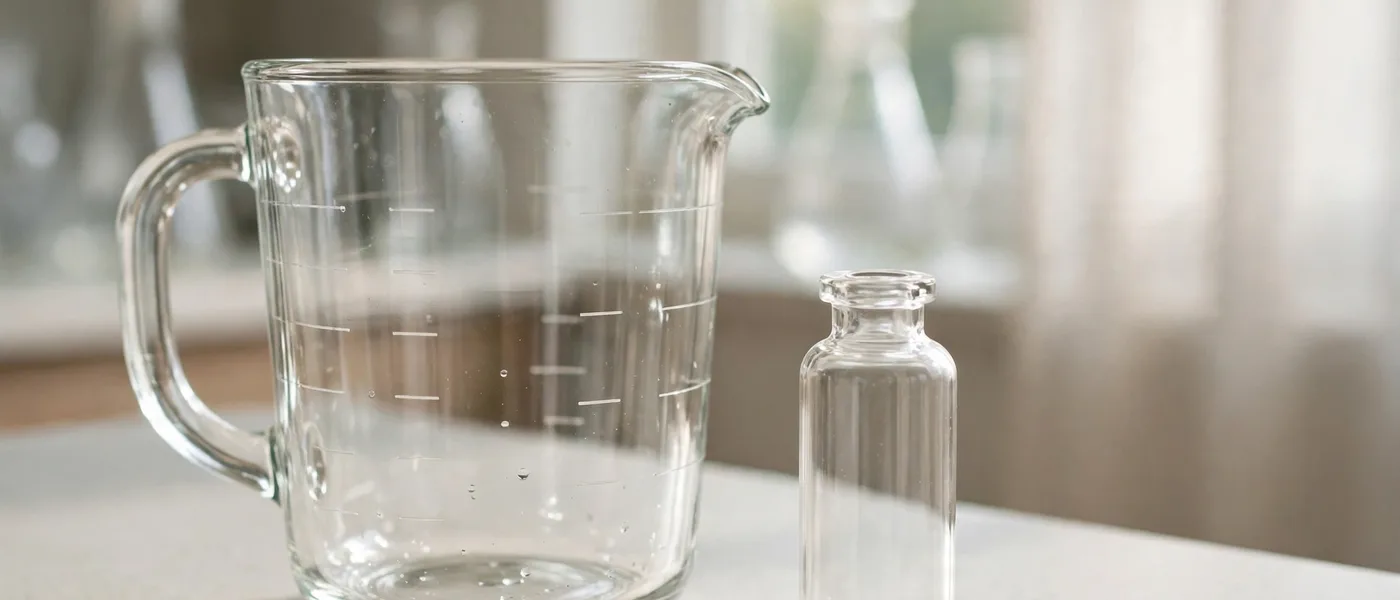
Milligrams and units measure two different things
The confusion behind semaglutide units to mg searches starts with two words that sound interchangeable but are not. A milligram, written mg, measures the amount of medicine itself, the mass of the drug in a dose. Every branded semaglutide dose is stated this way on its label, for example 0.25 mg, 0.5 mg or 2.4 mg once a week. A unit, in the sense people mean when they talk about syringe markings, measures volume, how much liquid is drawn up. Syringes used with vials are marked in units of liquid, not in milligrams of drug.
Because one word measures drug and the other measures liquid, there is no dictionary style translation between them. The bridge between the two is a third piece of information: the concentration of the liquid in the vial, meaning how many milligrams of drug are dissolved in each amount of liquid. Without that number, a unit count says how much liquid is involved and nothing at all about how much semaglutide is in it.
Why concentration changes everything
Concentration is not a standard. Branded pens present one fixed product, but semaglutide also reaches patients as compounded vials prepared by pharmacies, and compounded products are not FDA approved. Different pharmacies prepare vials at different strengths, vials can change when a prescription is refilled or a pharmacy changes its preparation, and two vials that look identical can hold liquid of quite different strength. The same volume drawn from each would deliver different amounts of drug.
This is why a conversion that is correct for one person's vial can be wrong, and potentially seriously wrong, for another person's vial, even when the medicine name and the syringe look exactly the same. Any chart, post or calculator that states a single fixed answer for what a number of units equals in milligrams is silently assuming one particular concentration. If your vial is not that concentration, the answer does not apply to you, and there is no way to tell from the unit number alone.
How many mg is 40 units of semaglutide?
This is one of the most common questions on this topic, and the honest answer is that it cannot be answered from the number 40 on its own. Forty units describes a volume of liquid. What that volume contains in milligrams depends entirely on the concentration of the specific vial the liquid came from, and concentrations vary by product and by pharmacy. A page that gave a single milligram figure here would be guessing at your vial, and a wrong guess about a dose is not a harmless error.
What can be said is who holds the missing piece. The concentration is set by the product or by the pharmacy that prepared the vial, and the prescriber who ordered it and the pharmacist who dispensed it both work with it directly. If a dose has been described to you in units, those are the people who can state what it means in milligrams for your vial, and they can do it from the actual product in front of them rather than from an assumption. Ask them, and ask again whenever a vial, pharmacy or prescription changes.
Why branded pens never need this conversion
Ozempic and Wegovy are delivered in pens that are built around milligrams from start to finish. The pen for each dose strength is labeled in mg, the dose is set and delivered in mg, and the published schedules on this site are written in mg. At no point does a pen user measure liquid or think in syringe units. The whole units question only appears when medicine is drawn from a vial with a syringe, which in practice means compounded semaglutide vials rather than the branded pens.
That difference is worth noticing if you are comparing treatment routes. A pen removes an entire layer of measurement, and with it an entire category of possible mistakes. A vial route places that measurement in human hands every week, against a concentration that has to be known and checked. Neither fact decides which route is right for a person, but the difference is real, and it belongs in the conversation with a prescriber.
Who can interpret your specific vial
Only two people are positioned to interpret a specific vial safely: the prescriber who ordered it, and the pharmacist who prepared or dispensed it. They know, or can look up, the concentration of that exact product, and your prescription was written against that concentration. Everyone else, including websites, forums, social media posts and other patients, is working without your vial in front of them, however confident they sound.
Practical steps that stay on the safe side of this line: keep the vial together with its pharmacy paperwork, do not rely on a unit number remembered from a previous vial or a previous pharmacy, and treat any change of vial, pharmacy or prescription as a reason to have the dose meaning confirmed again in writing. If the units you have been told and the paperwork do not clearly line up, pause and ask before injecting, not after. Your pharmacist expects exactly this kind of question, and asking it is normal, not a nuisance.
Frequently asked questions
How many mg is 40 units of semaglutide?
It cannot be worked out from the number 40 alone. Units measure a volume of liquid, and the milligrams in that volume depend on the concentration of the specific vial, which varies by product and pharmacy. Only your prescriber or the pharmacist who dispensed your vial can state what 40 units means for that vial.
Why is there no standard semaglutide units to mg conversion?
Because the two measures describe different things and the link between them, concentration, is not standard. Branded pens deliver set doses labeled in milligrams, while compounded vials, which are not FDA approved, are prepared at different strengths by different pharmacies. The same volume from two different vials can contain different amounts of drug.
Do Ozempic and Wegovy pens use units?
No. The branded pens are labeled in milligrams and deliver doses in milligrams, following the published schedules of 0.25 mg up to 2 mg for Ozempic and 2.4 mg for Wegovy. Syringe units only enter the picture when medicine is drawn from a vial, which in practice means compounded products rather than branded pens.
Can I use a conversion chart from another patient or website?
No. Any chart is built on one assumed concentration. If your vial was prepared at a different strength, that chart gives a wrong milligram figure for your medicine, and the error would not be visible to you. Dose meanings should come from your own prescriber or pharmacist, based on your own vial.
What should I do if my dose was described in units and I am unsure?
Contact the prescriber who ordered the medicine or the pharmacist who dispensed it before injecting, and have them confirm what the unit figure means in milligrams for the vial you actually hold. Ask again whenever the vial, the pharmacy or the prescription changes, because the concentration may have changed with it.